


Introduction
In a context where prevention and self-monitoring are becoming cornerstones of modern healthcare, the connected health bracelet is emerging as an essential tool for athletes and active adults looking to monitor their daily physical condition. More than just a technological gadget, this wearable health device collects valuable biometric data—from heart rate monitoring to sleep tracking—which, when interpreted correctly, can guide your health decisions and optimize your athletic performance. With a global market projected to reach $74 billion by 2026, these wearable devices are revolutionizing our approach to well-being. This article reviews the scientific evidence, key features, current medical limitations, and the integration of these technologies into a proactive health strategy to help you make the best choice.
Why Choose a Connected Health Bracelet?
An Overview of Physiological Tracking Technologies
Modern connected health bracelets are now equipped with sophisticated sensors capable of measuring essential physiological parameters in real time. These wearable health devices integrate cutting-edge technologies such as photoplethysmography (PPG) for heart rate monitoring, triaxial accelerometers to detect movement, and sometimes even blood oxygenation (SpO2) sensors or advanced electrocardiograms (ECG).
Specifically, your connected health bracelet can measure:
- Continuous heart rate monitoring, both at rest and during exertion
- The number of steps taken daily and the distance covered
- The quality and cycles of your sleep
- Calories burned according to your metabolism
- Blood oxygenation for certain premium models
- Heart rate variability (HRV), a key indicator of stress and recovery
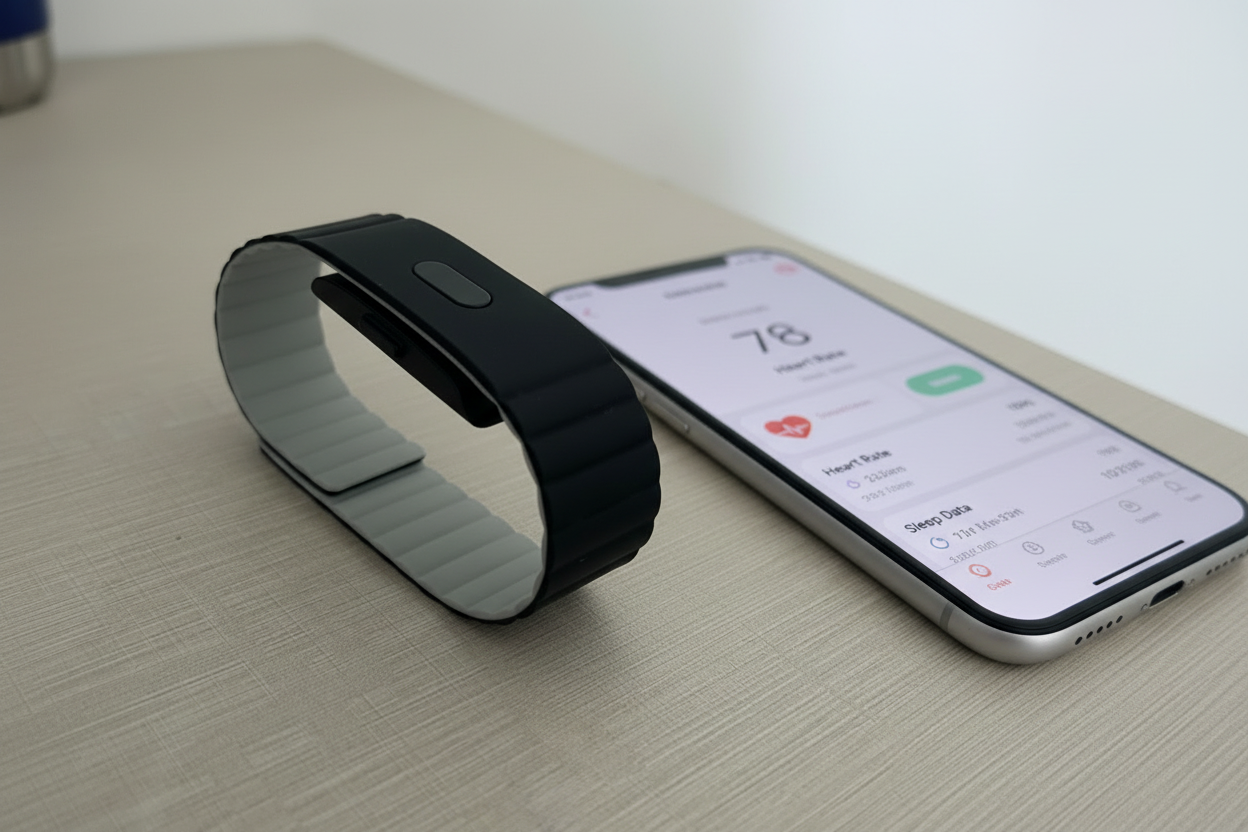
These measurements are made possible by artificial intelligence algorithms that analyze physiological variations throughout the day in a completely non-invasive way. The collected data is then synchronized with your smartphone via a dedicated app, transforming raw signals into actionable information for your health.
The Scientific Evolution of Health Wearables
Scientific research has largely validated the usefulness of these devices. Studies published in leading medical journals demonstrate that activity trackers can encourage healthier behaviors: regular users walk an average of 2,000 more steps per day and measurably improve their cardiovascular health. This gamification of health creates a positive feedback loop that motivates people to maintain active habits in the long term.
For healthcare professionals, this longitudinal data offers a unique window into their patients' daily lives, complementing one-off examinations with a continuous view. Some hospitals are already integrating this information into electronic health records (EHRs) to refine diagnoses and personalize treatments, marking a transition towards preventive and predictive medicine.
The Role of Cardiac Monitoring in Active Health
Real-Time Heart Rate Measurement
For anyone who is athletic or physically active, heart rate monitoring is a key indicator of performance and recovery. Wearable health devices allow you to continuously monitor your resting heart rate (an important marker of your cardiovascular fitness), your heart's response to exercise (to optimize your training zones), and fluctuations throughout the day that can reveal stress or fatigue.
A recent meta-analysis has demonstrated that these devices can provide reliable heart rate data in real-life settings, with 90-95% accuracy at rest and 85-90% during moderate exercise. While accuracy may vary depending on the model, the quality of skin contact, and the intensity of the activity, modern connected health bracelets are now competing with traditional chest straps for everyday use.
Clinical and Sports Applications of Cardiac Monitoring
In a medical and sporting context, this data is of considerable interest. For the prevention of cardiovascular risks, the early identification of irregularities such as atrial fibrillation can literally save lives. Numerous accounts report early diagnoses thanks to alerts from their wristbands, enabling rapid medical intervention before the onset of serious complications.
For athletes to optimize their training, a continuous heart rate monitor helps define effective training zones. Rather than training blindly, you can precisely target your sessions: aerobic zone for endurance, anaerobic zone for power, or active recovery zone. This scientific approach to training reduces the risk of overtraining and improves performance by 10 to 15%, according to several longitudinal studies.
Heart rate variability (HRV), measured by advanced fitness trackers, provides an even more detailed insight into your recovery status. A high HRV indicates that your autonomic nervous system is functioning well and that you are ready for intense training, while a low HRV suggests prioritizing rest or light activity. This metric becomes a true personal coach, guiding you day after day.
Sleep Tracking: A Window into Recovery
How a Bracelet Analyzes Your Sleep
Sleep tracking represents one of the major innovations of connected health bracelets. This feature relies on sophisticated algorithms that combine movement data (via the accelerometer) and heart rate to accurately estimate the total duration of your sleep, episodes of nighttime awakenings, and above all the distribution between the different phases: light sleep, deep sleep and REM sleep.
Each phase plays a crucial role in your recovery. Deep sleep promotes physical regeneration and the consolidation of long-term memories, while REM sleep is essential for emotional processing and creativity. A connected health bracelet allows you to visualize these cycles and identify factors that disrupt your rest: stress, late-night caffeine consumption, an unsuitable bedroom temperature, or even undiagnosed sleep apnea.
Limitations and Medical Interpretations of Sleep Monitoring
This approach doesn't yet reach the precision of a clinical polysomnography performed in a sleep lab, which remains the medical gold standard with its multiple electrodes measuring brain activity, eye movements, and muscle tone. However, for everyday use, the bracelets provide a very useful overview, particularly for tracking the impact of stress, intense training, or jet lag on your recovery.
Recent studies show that these measurements don't always perfectly correlate with actual sleep patterns—especially for deep sleep or REM sleep—meaning you should interpret this data with caution and not focus excessively on minor variations. The important thing is to observe trends over several weeks rather than worrying about a single bad night.
For people suffering from severe sleep disorders (chronic insomnia, obstructive apnea), the bracelet can serve as an initial screening tool, but a specialist medical consultation remains essential for an accurate diagnosis and appropriate treatment.
Wearable Health: From Wellness to Preventive Medicine
Increasingly Advanced Health Markers
With the integration of artificial intelligence and increasingly sophisticated sensors, modern wearables go far beyond simple traditional fitness tracking. The latest generation of connected health bracelets can now measure your respiratory rate (an early indicator of stress or illness), your oxygen saturation (particularly useful at altitude or for detecting respiratory problems), your physiological stress levels, and even provide personalized estimates of your metabolic age based on large comparative databases.
Some premium models incorporate skin temperature sensors that can detect subtle variations related to fever, the menstrual cycle, or post-exercise recovery. Others offer hydration or body composition measurements via bioelectrical sensors. This technological convergence transforms the bracelet into a veritable wearable laboratory that monitors your health from every angle.
Future Clinical Potential and Predictive Medicine
Medical research is converging towards the complementary use of wearable data in electronic health records (EHRs). Recent studies suggest that better prediction of the risks of chronic diseases—type 2 diabetes, hypertension, cardiovascular diseases—becomes possible when continuous data from wristbands is combined with traditional clinical data (blood tests, family history, physical examinations).
This preventive medicine approach makes it possible to identify at-risk individuals before symptoms appear, paving the way for early interventions (lifestyle modifications, preventive treatments) that can literally change the course of a disease. Several pilot programs in university hospitals are already testing this integration with promising results: reduced hospitalizations, better adherence to treatments, and improved quality of life for patients.
Practical Use Cases for Athletes and Active Adults
Optimizing Sports Training
For athletes, whether passionate amateurs or elite competitors, a connected health bracelet like JYCEN offers continuous measurements that allow for fine-tuning the intensity of training sessions. Rather than following a generic program, you can personalize each session according to your actual condition: if your HRV is high and your resting heart rate is low, it's the ideal time for an intense workout; if these indicators are poor, prioritize active recovery or complete rest.
Monitoring cardiac recovery after exercise is another valuable indicator. A heart rate that drops rapidly after intense exercise signals good cardiovascular fitness, while a slow recovery may indicate accumulated fatigue or the beginning of overtraining. This information supports an approach based on personalized training zones rather than subjective sensations, which can be misleading.
Runners, cyclists, and swimmers particularly appreciate advanced metrics such as estimated VO2 max (maximum aerobic capacity), running cadence, stride efficiency, and power output. This data transforms every training session into an opportunity for learning and continuous improvement.
Injury Prevention and Load Management
Nighttime fatigue, revealed by poor sleep quality or sudden changes in resting heart rate, can precede injury or a drop in performance by several days. The longitudinal tracking provided by your connected health bracelet allows you to identify these warning signs before they become problematic, giving you the opportunity to adjust your training load or consult a professional.
For busy adults juggling work, family, and physical activity, the bracelet helps find the right balance. It makes it easy to visualize the impact of a stressful week at the office on your sleep and recovery, encouraging you to prioritize rest rather than forcing yourself into a workout that could be counterproductive.
Daily Motivation and Empowerment
Beyond advanced metrics, simply visualizing your data creates a powerful gamification effect. Daily goals (10,000 steps, 30 minutes of moderate activity), achievement badges, challenges with friends, and movement reminders boost motivation in a fun way. This empowerment transforms behaviors: taking the stairs instead of the elevator, parking further away, going for a walk after dinner. These small, cumulative decisions generate significant long-term results.
Limitations and Medical Recommendations
Wearables are not certified medical devices.
While some connected health bracelet models are used as complementary tools in clinical settings, most lack strict medical approvals such as FDA (United States) or CE medical marking (Europe). They primarily serve to track trends and encourage healthy behaviors rather than to make formal medical diagnoses.
This distinction is crucial: if your bracelet detects a heart abnormality or a sleep problem, it should prompt you to consult a healthcare professional, not to self-diagnose or modify an existing treatment. Algorithms, however sophisticated, cannot replace the clinical expertise of a doctor who considers your complete medical history and symptoms and can prescribe further tests.
Interferences and Precautions for Use
Studies have occasionally noted that some fitness trackers can potentially interfere with implanted medical devices such as pacemakers or automated external defibrillators (AEDs), although these cases remain rare. Patients with these devices should absolutely consult their cardiologist before regularly using a connected health bracelet, as a precaution.
Furthermore, the accuracy of the measurements can be affected by several factors: tattoos on the wrist (which interfere with the optical sensors), the bracelet being worn too loosely or too tightly, sudden movements during very intense exercise, or even extreme ambient temperature. Understanding these limitations allows for a more discerning interpretation of the data.
Protection of Personal Health Data
Your biometric data is sensitive and deserves rigorous protection. Choose reputable brands that comply with the GDPR (General Data Protection Regulation) in Europe, with transparent privacy policies. Check where your data is stored (ideally on European servers), whether it is encrypted, and whether you retain full control (the ability to export or delete it at any time).
Be wary of apps that automatically share your data with third parties (insurers, employers, advertisers) without your explicit consent. Your health belongs to you, and so does your data.
SEO-Optimized FAQ: Your Questions About Connected Health Bracelets
1. What exactly is a connected health bracelet?
A connected health bracelet is a wearable health device equipped with sophisticated biometric sensors that continuously measure physiological data such as heart rate, physical activity, sleep quality, and sometimes blood oxygen levels. This information is synchronized with your smartphone to guide the monitoring of your daily health and optimize your athletic performance.
2. Is heart rate monitoring from wearables really reliable?
Modern connected health bracelets can be very reliable for measuring heart rate under normal conditions, with an accuracy of 90-95% at rest. However, accuracy varies depending on the model, the intensity of the exercise, and the quality of skin contact. These devices do not replace a professional clinical examination but provide useful trends for daily monitoring.
3. Is sleep monitoring useful from a medical point of view?
Yes, sleep tracking provides a valuable estimate of the duration and quality of your rest, as well as the distribution between light, deep, and REM sleep phases. While it doesn't replace a clinical polysomnography in cases of suspected sleep disorders, it can help identify trends and disruptive factors to improve your daily sleep hygiene.
4. How can I effectively integrate a wearable device into my overall health plan?
Use the data from your connected health bracelet to guide your daily routines: adjust the intensity of your workouts based on your recovery, improve your sleep by identifying disruptors, and increase your physical activity with daily goals. Share this information with your doctor or sports coach for personalized and comprehensive care.
5. Can wearables really prevent diseases?
Connected health bracelets contribute to the continuous monitoring of important parameters and can help detect significant changes early (cardiac arrhythmias, sleep disorders, excessive sedentary behavior). They also encourage preventative behaviors by motivating you to stay active. However, they should be used in conjunction with regular medical checkups and professional monitoring, never as a replacement.
Conclusion: Your Health Deserves the Best Care
The connected health bracelet has established itself as a scientifically supported and clinically relevant tool for athletes and active adults who take their well-being seriously. Thanks to continuous and precise measurements—from heart rate monitoring and sleep tracking to recovery analysis—these health wearables are profoundly transforming how we understand and manage our physical condition on a daily basis.
These wearable devices are not mere technological gadgets, but true health partners that support you 24/7 in your quest for a more active and balanced life. They democratize access to physiological data once reserved for medical laboratories, empowering you to take informed action regarding your health.
However, always keep in mind that these tools are primarily complements to professional medical care, not replacements. No matter how advanced the technology, it cannot replace the expertise of a doctor, cardiologist, or qualified sports coach who can interpret your data within its overall context.
👉 Ready to optimize your performance and health? Discover JYCEN 's advanced solutions, specially designed to meet the demanding needs of athletes and active adults. Our connected health bracelets combine medical precision, elegant design, and exceptional battery life to support you in all your sporting and everyday challenges.
Explore our collection and find the bracelet that will transform your approach to health. For optimal integration into your routine, don't hesitate to consult your doctor or professional coach who can guide you in interpreting your data and adjusting your goals. Your journey to optimized health starts today!
Share:
Health Bracelet: The Complete Guide to Choosing Your Connected Companion in 2025